

Master 2
The second year of the Master (M2) is taught exclusively in English and students will acquire in-depth knowledge in different fields of Genetics.

The curriculum combines core courses with a wide selection of intensive one-week elective modules covering major areas of modern genetics, including human genetics, epigenetics, evolutionary and developmental genetics, high-throughput data analysis, cancer biology, stem cells, and neurodevelopment.
Students select seven modules from a broad catalogue to design a personalized academic program and may also attend advanced courses offered at the prestigious Pasteur Institute. Teaching is delivered by leading researchers, clinicians, and industry experts from universities, research institutes, hospitals, and biotechnology companies.
The program emphasizes experimental design, data analysis, critical thinking, and scientific communication, and includes a six-month internship in France using cutting-edge techniques. Students also participate in an international workshop with partner universities in Italy, Greece, and Spain, fostering the development of a strong professional and research network.
Key numbers
- 100% of our students successfully complete their M2
- 95% of our students who wished to start a PhD succeed in obtaining funding: 50% through a Doctoral School competition and 50% through another channel
International students
If you are an International student, you can find all the information regarding life in France here.
If you are a top international student, through our G.E.N.E. Fellows program, you can directly arrive to the second year of the European Master’s in Genetics. Click here for more information.
Read more
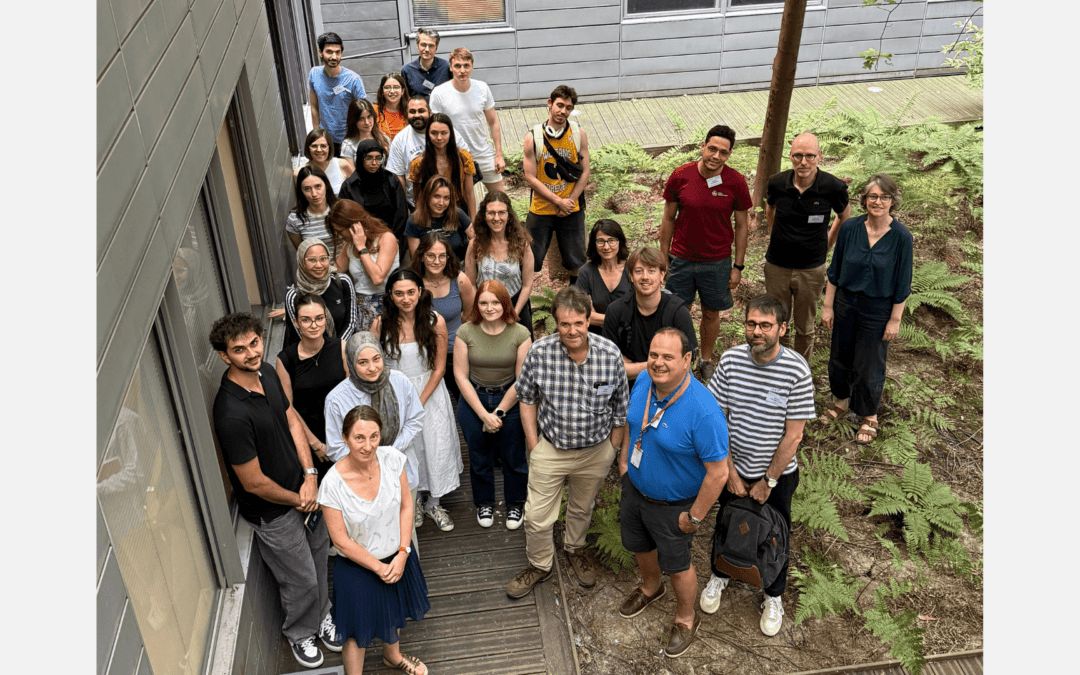
“Frontiers in Genome Stability and Dynamics”: A look back at the summer school at the heart of the 3Rs
From July 6th to July 8th, 2026, the Graduate School G.E.N.E. and the Institut Jacques Monod (Université Paris Cité) hosted the "Frontiers in Genome Stability and Dynamics" summer school at the Pierre-Gilles de Gennes Amphitheatre (Campus des Grands Moulins).All the...
![[Faculty Mobility Grant] Sandrine Caburet, Associate Professor, shares her experience at the REBIF and JOBIM events in Strasbourg](https://eur-gene.u-paris.fr/wp-content/uploads/sites/7/2026/08/Sans-titre-1920-x-1080-px941-1080x675.png)
[Faculty Mobility Grant] Sandrine Caburet, Associate Professor, shares her experience at the REBIF and JOBIM events in Strasbourg
Our Graduate School G.E.N.E. is pleased to announce the very first mobility grant awarded to a faculty member within our Magistère Européen de Génétique. We supported Sandrine Caburet, Associate Professor, through our mobility funding scheme, for her participation in...
![[Mobility Grant] Léa Livramento presents her research at FENS Forum, Europe’s leading neuroscience conference, in Barcelona](https://eur-gene.u-paris.fr/wp-content/uploads/sites/7/2026/08/Sans-titre-1920-x-1080-px921-1080x675.png)
[Mobility Grant] Léa Livramento presents her research at FENS Forum, Europe’s leading neuroscience conference, in Barcelona
Our Graduate School G.E.N.E. is pleased to announce that Léa Livramento, a 2nd-year PhD student in the BioSPC Doctoral School (ED562), is a recipient of our mobility grant. This scheme provides financial support to master's and PhD students wishing to present their...

From Academia to Startups: Keys to a Successful Professional Transition
On Thursday, June 18, the Young Epigenetics Scientists (Y.E.S.) Club and our Graduate School G.E.N.E. hosted two professionals who successfully transitioned from academia to startups: Kim Brunel, Founder and CEO in residence at Biossible, and Salomé Guez, Research...